
Menu
Close
November 22, 2019
Service & Communication Design Case Study
This project is part of Noora Health’s ongoing research to understand the impact of its programs and services on health outcomes and to refine them for better efficacy.
The Care Companion Program (CCP) by Noora Health in collaboration with local government and hospitals, equips families with the skills to care for their loved ones. Aarogya Seva is a Whatsapp service for CCP through which messages regarding caregiving are sent to families at home.
In this project, I study the family caregiver ecosystem in low-resource settings, with a focus on fathers’ involvement during pregnancy to improve health outcomes of pregnant mothers.Communication for Noora Health’s Whatsapp service, called Aarogya Seva, is designed for better quality and impact.
Background:
References: 1 “Maternal Mortality: Newsroom Fact Sheets.” World Health Organization, World Health Organization, 30 Aug. 2021, https://www.who.inteurope/news-room/fact-sheets/item/maternal-mortality 2 Review and Meta-Analysis.” Research Gate, Division of Epidemiology and Public Health, University of Nottingham, 19 Feb. 2015, https://www.researchgate.net/publication/272521114_Male_involvement_and_maternal_health_outcomes_Systematic_review_and_meta-analysis 3 Sarvar, Rana, and Rekha Sonavane. “MaleInvolvement in Antenatal and Natal Care Practices of Their Partners – a Community-Based Study in Rural Area of North Karnataka.” Public Health Review: International Journal of Public Health Research, 30 June 2018, https://publichealth.medresearch.in/index.php/ijphr/article/view/88.
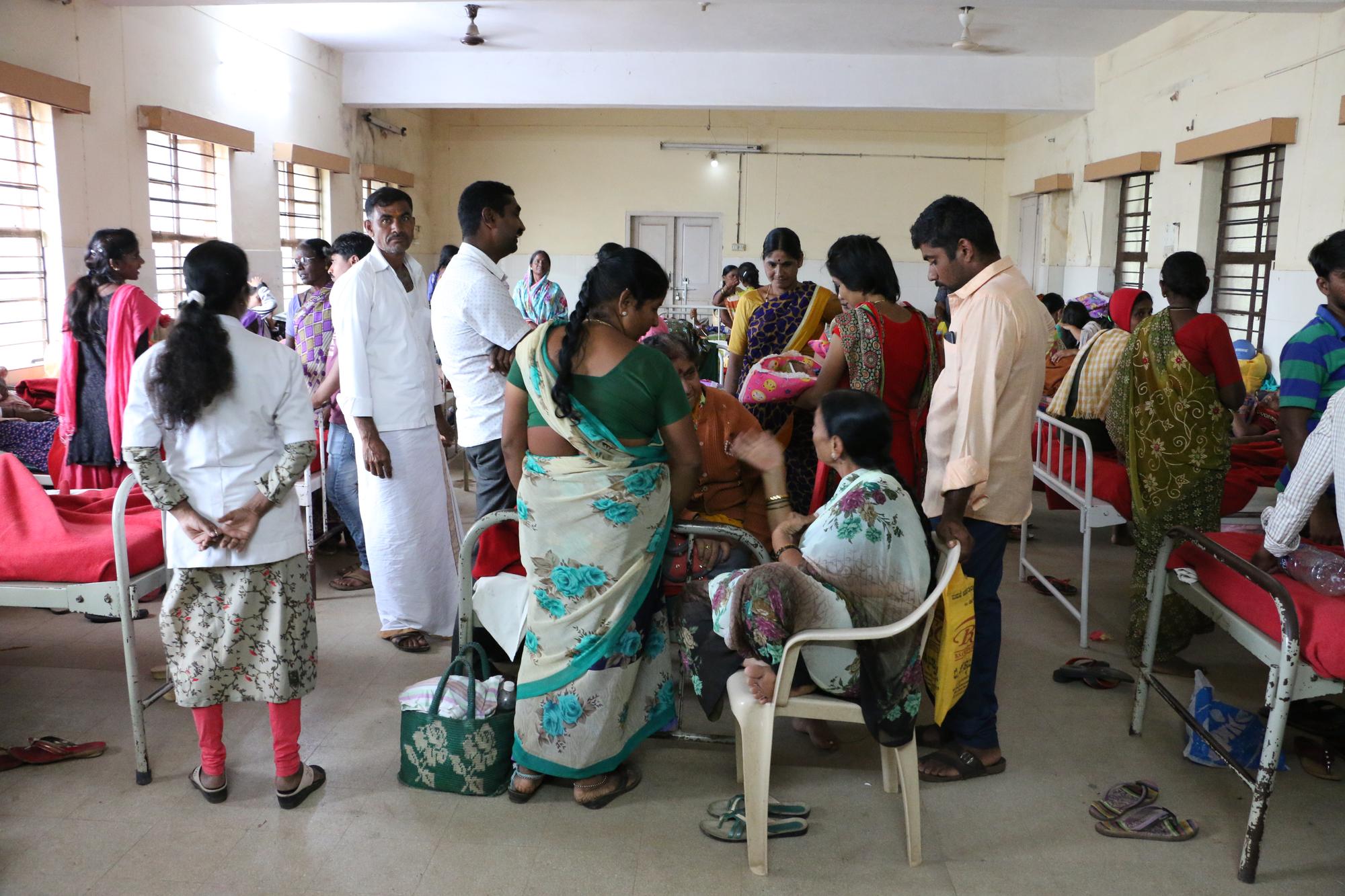
Approach to needsfinding: The following insights have been drawn from primary and secondary research including observations and interviews of patients and families, conducted at ANC wards in public hospitals across Karnataka, India. (Districts: Davangere, Belgaum and Bangalore)
Observations from hospital visits: • Men are excluded from decisions or actions relating to pregnancy. They are barred from entering the facility by nurses and security staff. Their role is mostly restricted to gathering resources and tools. • Being regarded as a women’s job, most tasks are often taken up by the mother-in-law or sisters. Tasks are distributed among female members of the family while male members wait to be told what to do. • Emotional reactions: Clueless and embarrassed, father’s often feel like it is not their place to be. Meanwhile, father’s addiction to substances causes worry to the mother, especially before birth of a child.
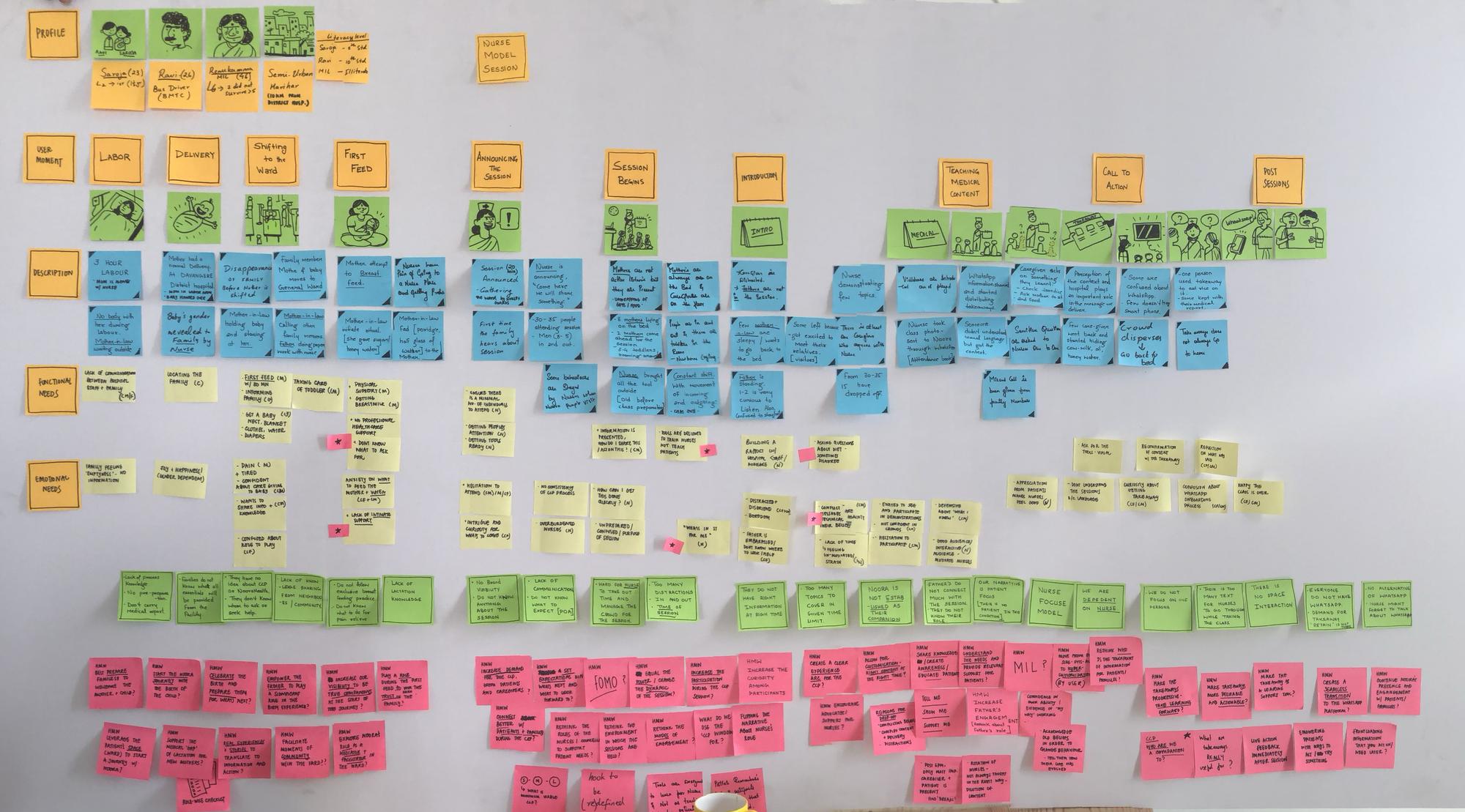
Journey Map: We traced the mother’s journey through child-birth to study the nature of involvement of family caregivers, especially the father. Journey maps were also essential in understanding functional and emotional needs of the mother and the family.
Key decision makers:
Mother: Patient
Father: Secondary caregiver
Mother-in-law: Primary decision makers regarding pregnant mother’s health
Hospital staff: Authority allowing access of family members to patient wards
Problem:
Fathers are an accessible and ready resource excluded from activities concerning health of a pregnant mother.
How Might We:
Involve fathers in care for pregnant mothers in order to improve health outcomes for both mother and child.
Desired Outcomes:
A. Increase in care seeking behaviours practiced by family. B. Impact fathers can have on influencing maternal behaviours and reducing maternal stress through emotional, logistical and financial support. C. Involved father or male partner during pregnancy leading to reduction of maternal stress and the encouragement of positive maternal behaviours.
Undesired Outcomes:
A. Husband’s increased knowledge decreases the wife’s decision-making ability. B. Reinforcing male decision-making leads to discrimination against women.
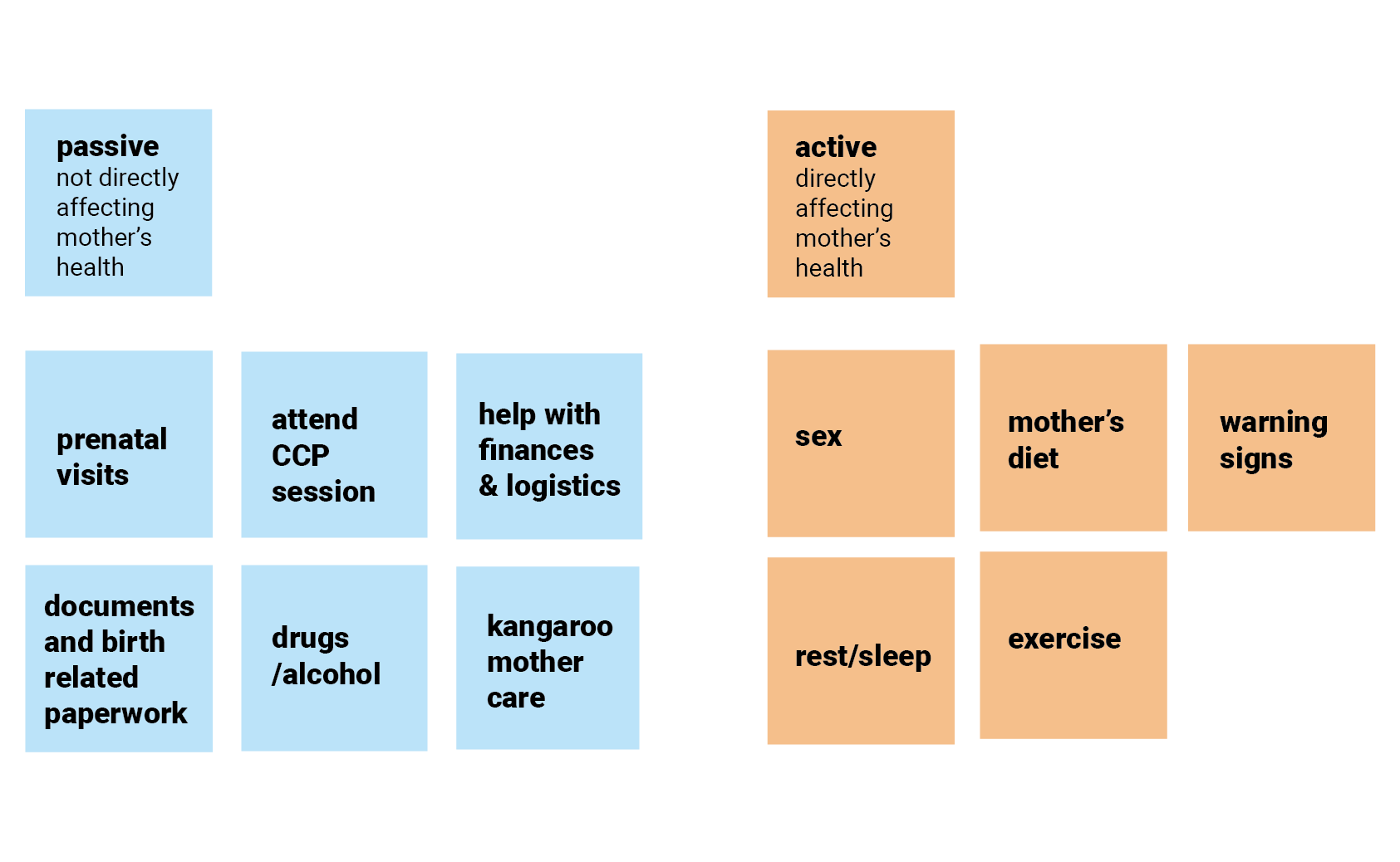
First, I identified health topics concerning mother (and child) during antenatal period of pregnancy. This was partly derived from Noora Health’s CCP curriculum designed after an initial needsfinding by the medical team.

Second, I mapped health topics that require male participation only in terms of support, such that it doesn’t compromise mother’s decision-making regarding her own health.
What is Aarogya Seva: A Whatsapp service for the Care Companion Program (CCP). At the end of the CCP session, patients and families sign up to Aarogya Seva on Whatsapp and start receiving messages regarding mothers health for questions that might arise during caregiving at home.
How it works:
1. CCP training is conducted by nurses at hospital
2. Patient families subscribe to Whatsapp Service
3. Families start receiving health messages

Improving efficacy of the Whatsapp Service: We assume that a better understanding of the family caregiver system will help improve the quality of communication for better adherence of healthy behaviours. At first, messages for Aarogya Seva were composed as general health instructions for the pregnant mothers, who may not be the main decision maker. We paraphrased messages to address individual members, especially the father, to support caregivers by organising tasks and making care at home less stressful for families.
Solution: Supporting fathers with tips and know-hows for caregiving during pregnancy. Messages regarding male involvement delivered through Whatsapp reach directly to the father, usually the primary provider and the one with direct access to a smartphone. All messages are translated in local languages.
Subject: Call-out, Details of task Body: Explanation (How & why to be involved in care) Tone: Friendly, Supportive, Directed to father
.png)

Content, Planning & Design Kanika Anand
Design Lead Samina Rahman
Thought Partners Tropic Design